Fleet & ADAS Operations Platform
A fleet operations platform that unifies multiple sensor classes, trip evidence, device health, driver accountability and multi-tenant fleet management into one operational product: designed, engineered and shipped end-to-end by ScroBits.
What was breaking before we started
The ADAS hardware was already in trucks. The problem was that the people who had to act on it could not trust what the screen was telling them.
Devices go dark, unnoticed
Devices go silent for weeks without anyone noticing, so the safety system is off exactly when it matters most.
No defensible evidence
Disputed accidents get settled with no defensible trip evidence, leaving fleets exposed to insurers and customers alike.
Fitted, or just quiet?
There is no way to tell "sensor not fitted" apart from "sensor not reporting", so real gaps hide behind ambiguous ones.
Compliance, built by hand
Compliance reports get assembled by hand every month, a recurring tax on the team that should be watching the road, not a spreadsheet.
What the operators actually said
A full-stack development engagement
The ADAS and telematics hardware was already fitted across the fleet. What was missing was the software layer that could ingest signals from five different device classes, prove device health in real time, and give fleet operators evidence they could defend when something went wrong.
ScroBits built that layer: ingestion pipelines across the five sensor classes, a monitoring engine that audits the platform itself across six failure classes, a multi-tenant provisioning layer with per-fleet isolation, APIs across the fleet domain, a rebuilt operator frontend, and the deployment pipeline that puts it all in production.
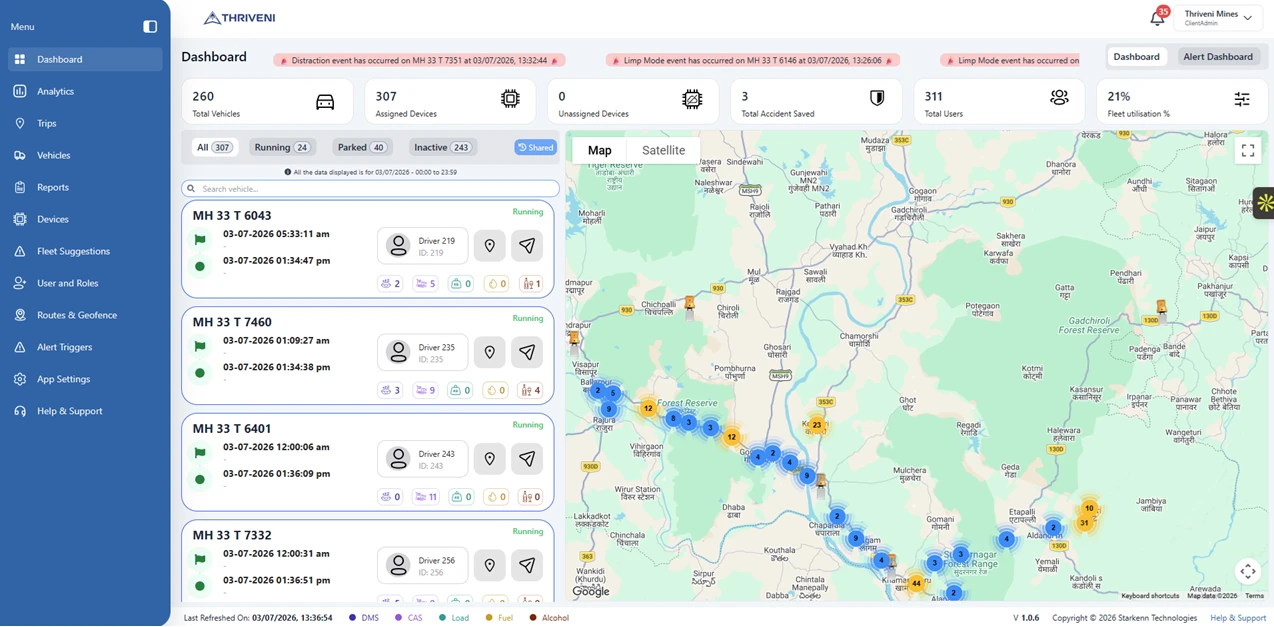
What runs today is a production platform across 260 vehicles and 307 devices, with new fleets going live in minutes instead of deployment cycles, trip evidence available on demand, and compliance reporting that no longer eats a day a month.
Five device types ingested, correlated and surfaced in a single operational product. Built across backend, APIs, frontend and multi-tenant platform in one engagement.
Five modules, one operational product
Each module solves one of the four pains above and adds a self-serve surface so the OEM’s growth is not throttled by delivery capacity.
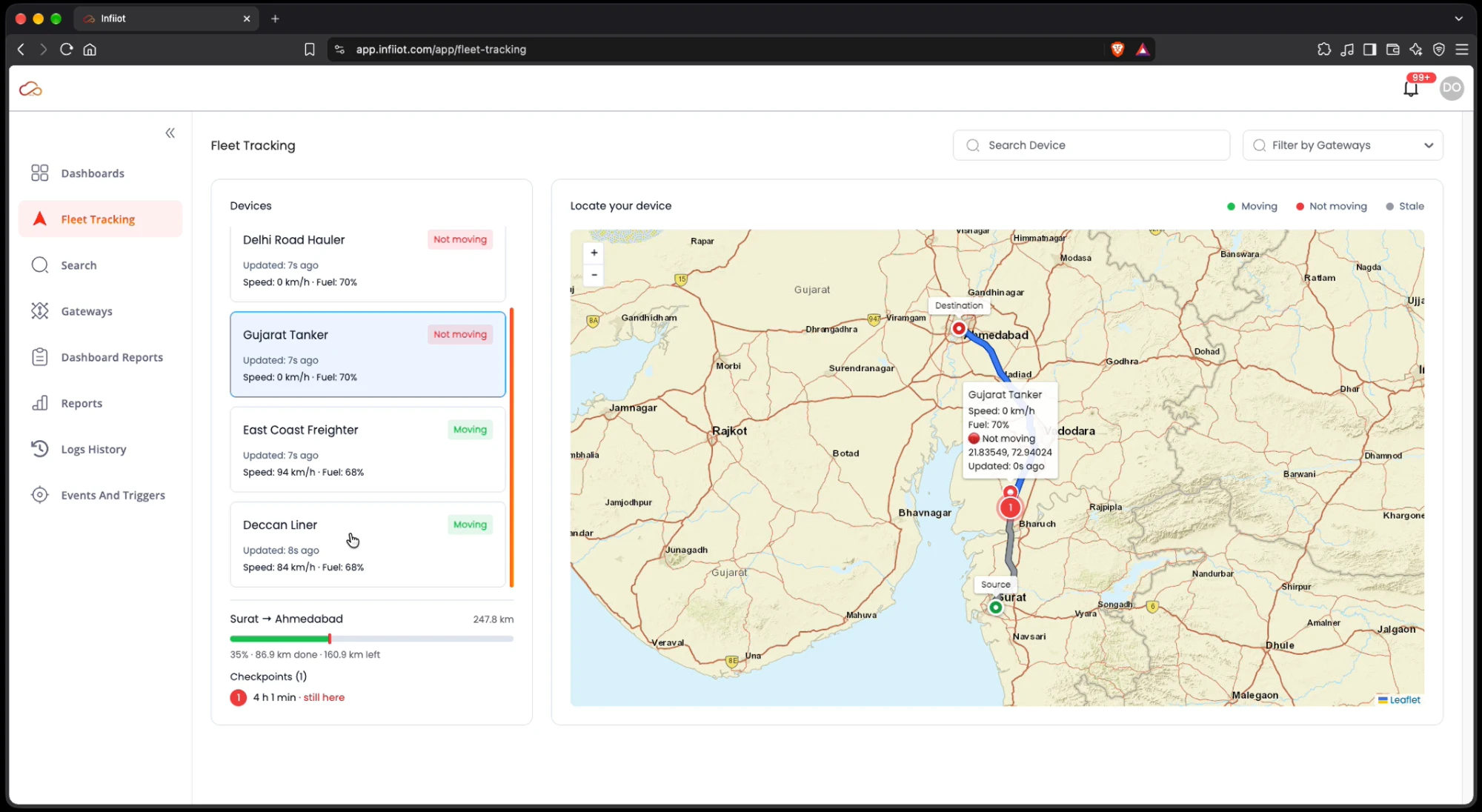
Unified Console
Five sensor classes in one live view, with per-vehicle linkage status visible as a tile, not a mystery.
Evidence On Demand
Trip playback from 1x to 10x, with alerts pinned to the route so a dispute closes in minutes.
Fleet Health Intel
A nightly engine audits the monitoring system itself across six failure classes, each with priority and age.
Accountability Layer
Driver scoring, geofenced routes and planned-versus-actual on every job the fleet runs.
Multi-Tenant SaaS
New fleets provisioned in minutes, each with their own branding, roles and data walls.
Before, after, change
The buyer is not paying for sensor accuracy. They are paying for a defensible answer when a truck is involved in an incident, and for proof that the safety investment is actually running.
| Problem area | Before | After | Change |
|---|---|---|---|
| Silent devices undetected | Weeks of blind coverage | Flagged within 48 hours | Real time |
| Accident disputes | Settled without evidence | Trip playback as record | Defensible |
| Monthly compliance reporting | Manual, multi-day | Scheduled and automated | Automated |
| New tenant onboarding | Deployment project | Configuration task | Self-serve |
Three principles we are taking into the next engagement
The dashboard is the product
Nobody evaluates your sensor during a buying decision. They evaluate the screen it feeds. Hardware specs win the demo, the UI wins the renewal.
Backend reliability is the dashboard's reputation
An operator trusts the screen only as far as they trust the signal behind it. Ingestion, device health and tenant isolation have to work before a single pixel earns credibility.
Monitor the monitoring system
If the platform cannot detect its own blind spots, the customer will discover them at the worst possible moment. Fleet Health Intel exists for that reason.
Shipping connected hardware and want the dashboard to earn its keep?
We work with ADAS, telematics and industrial IoT OEMs on exactly this problem. Design, full-stack build, production rollout.