Plant OEE across 100+ machines
Real-time availability, performance and quality intelligence derived from the one signal every machine already produces: its electrical load. Smart manufacturing without a single controller touch.
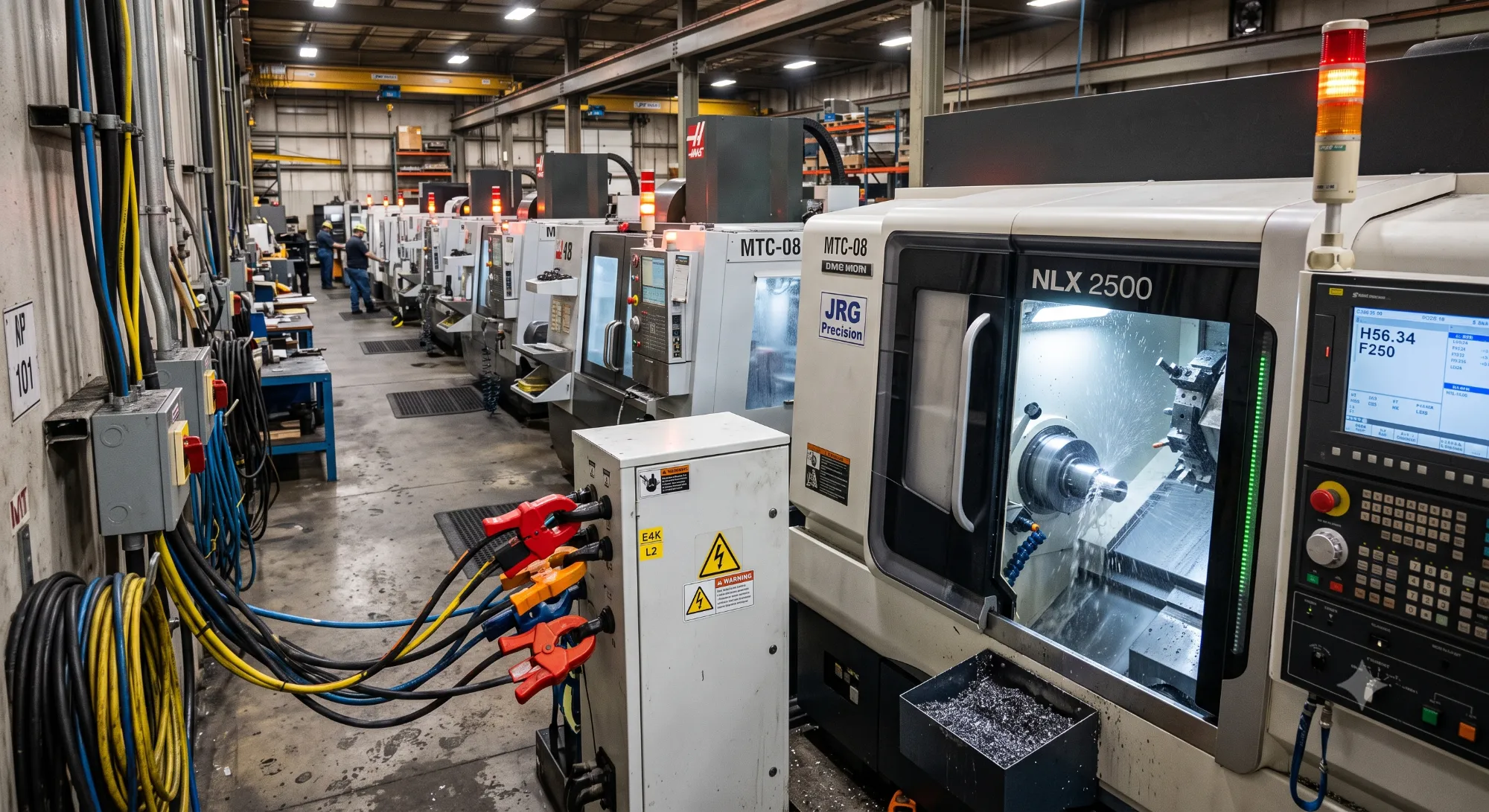
What was breaking before we started
The plant knew its machines were under-utilised. Nobody could tell by how much, or why. The obvious fix, reading directly from the CNC controllers, was closed by warranty, by thirteen protocol variants, and by OT security reviews stacked on each one.
Thirteen integrations, not one
13 CNC and BMC variants each needed their own controller protocol, driver and support contract. One OEE project became thirteen, which is why prior attempts never scaled past pilot.
Warranty and vendor exposure
Machines under OEM warranty could not accept a third-party tap on the control system. Controller-level integration put that warranty at risk on the plant’s most expensive assets.
OT security review, per protocol
Every new connection into the machine network needed its own approval cycle. 13 protocols meant 13 reviews before one sensor went live.
Paper logs nobody could trust
Downtime was logged by hand at end of shift. Industry data puts 50 to 70 percent of manually logged downtime as carrying no valid root cause.
What the plant actually said
Non-invasive sensing, derived intelligence
Direct CNC integration was closed by warranty exposure, thirteen controller protocols, and the OT security reviews stacked on each one. The plant needed OEE at machine, cell and plant level, in real time, across five sites, without touching a controller.
ScroBits built the full stack: non-invasive current and voltage sensing on the incoming supply, an edge gateway doing local signal processing, load-signature classification models per machine variant, a touch-screen reason-code interface at every machine, drift detection against learned baselines, and two delivery surfaces: SAP ERP for planning and shop-floor screens for the line, with a cross-plant control tower on top.
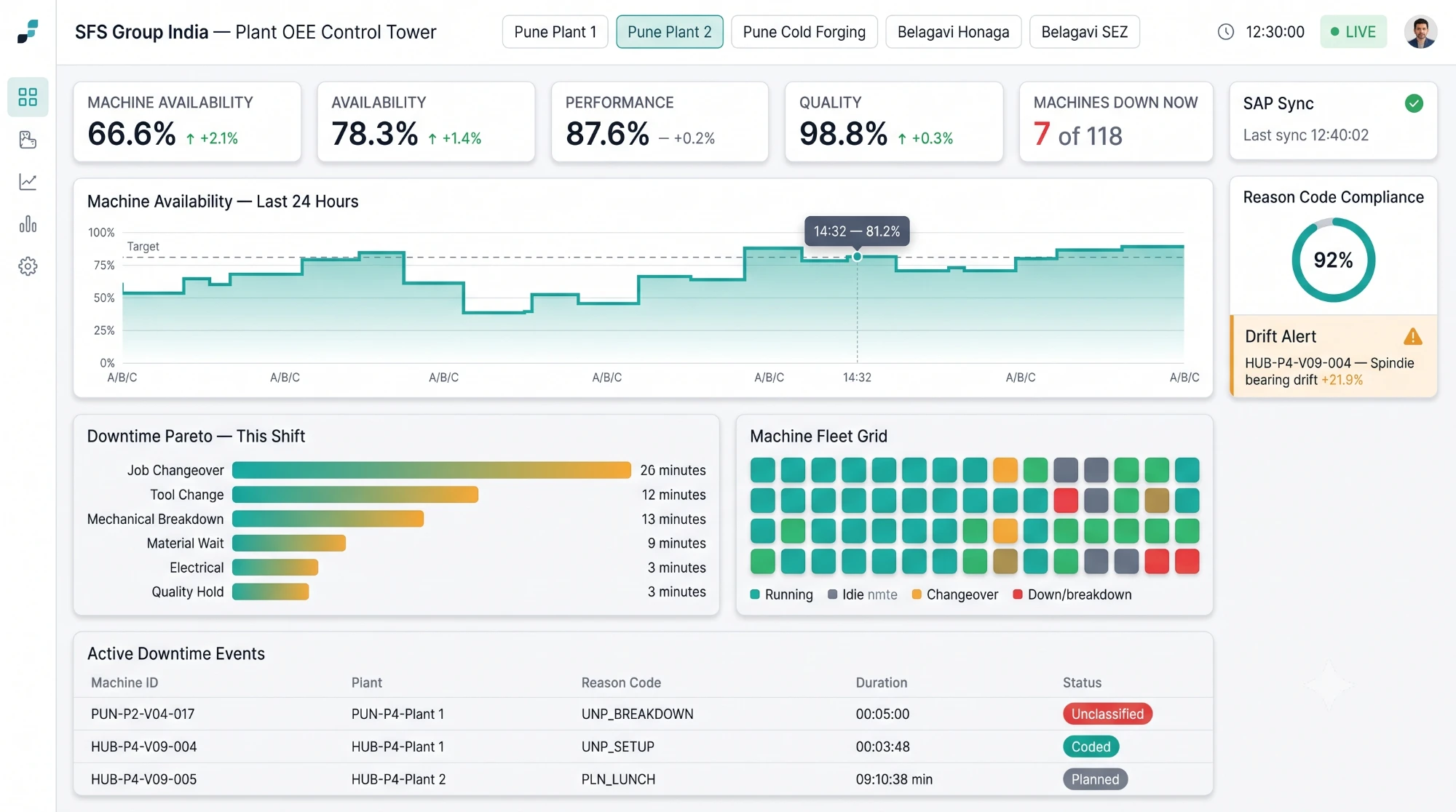
What runs today is 100+ machines across five plants, 13 variants under one deployment pattern, OEM warranty intact and the OT network unchanged. Supervisors stopped reconstructing shifts from paper.
All intelligence derived from the one signal every machine already produces: its electrical load. Thirteen integration projects become one deployment pattern.
Five building blocks, one live plant signal
Each block carries a specific job in the sense → classify → compute → deliver chain. Together they put real-time, reconciled OEE on the floor and in the ERP at the same time.
Non-invasive power signature
Split-core current transformers and a voltage reference clamp onto the incoming three-phase supply. Nothing wired into the machine. No controller, PLC or SCADA bridge.
Load-signature learning
A trained signature per machine variant maps real power, reactive power and power factor to off, idle, warm-up, cut, tool change, planned stop and unplanned stop.
Operator reason capture
A single-screen touch interface at each machine turns every unplanned stop into a classified one. Large buttons, no typing. Compliance climbed from 56% at pilot to 92% in steady state.
A, P and Q from one source
Availability from state plus reason. Performance from cycle behaviour inside the signature. Quality from output and reject counts. All three OEE components, one system.
Drift detection
Constant cycle, rising power draw is a machine telling you something is wearing out. Drift signatures caught spindle bearing wear roughly two weeks ahead of conventional vibration monitoring.
Sense
Non-invasive CT + voltage sensors sample incoming supply continuously.
Classify
Edge software matches live signature against learned variant bands.
Prompt
On unplanned stops, operator classifies reason via touch screen.
Compute
Availability, performance and quality computed per machine, cell, plant.
Detect
Drift and anomaly signatures evaluated against baselines.
Deliver
State and OEE flow to SAP ERP, shop-floor screens and the control tower.
Report
Shift and daily reports generated automatically from signal, no compile step.
Before, after, change
The plant moved from end-of-shift guesswork to real-time, classified, reconciled OEE at the machine, cell and plant level, without a single controller connection.
| Measure | Before | After | Change |
|---|---|---|---|
| Plant OEE | 58.4% | 66.6% | +8.2 pts |
| Availability | 71.2% | 78.3% | +7.1 pts |
| Unplanned downtime (min/machine/shift) | 96 | 71 | -26% |
| Downtime with no valid root cause | 63% | 8% | -55 pts |
| Operator reason-code compliance | n/a | 92% | from 56% at pilot |
| Time to know a machine is down | End of shift | Under 60 sec | Real time |
| Shift reporting effort | ~90 min/day | Automated | Eliminated |
Extending the signal beyond OEE
The sensing layer created an asset-level signal that extends naturally beyond availability, performance and quality. Each roadmap item follows the same non-invasive principle.
Energy accounting
Per machine, per part, per shift, using the same sensors. The plant already pays for power the OEM never reports on.
Tool-life prediction
Accumulated cut-signature exposure per spindle gives maintenance a data-backed replacement window instead of a calendar.
Automated loss-tree analysis
Attribute A, P and Q losses to specific causes from the signature archive, turning the Pareto into a maintenance plan.
Cross-plant benchmarking
Compare same-variant machines across the five sites to surface operational differences that site-level OEE alone hides.
Three principles we are taking into the next engagement
Let the physics do the work the controller refused to share
Non-invasive power signatures carry enough signal to classify every meaningful machine state. No controller tap, no OT exposure, no warranty risk.
Keep the pilot number honest
Reason-code compliance started at 56% and climbed to 92%. Real systems climb; they do not land perfect. Hiding the pilot number hides the system's maturity.
One deployment pattern beats thirteen
A signature library per machine variant lets new assets inherit the model. Plant expansion does not restart the modelling clock; thirteen integration projects become one.
Running a plant and want live OEE without a controller touch?
ScroBits partners with manufacturing teams to engineer production AI systems in Cloud, DevOps, IoT and GenAI. If this case study maps to a problem you are living with, we would like to compare notes.